
Carbonetica Registry: one registry, a purpose-built system.
The Carbonetica case study: a bilingual portal and bespoke software connecting projects, documents, carbon credits and operational rules.
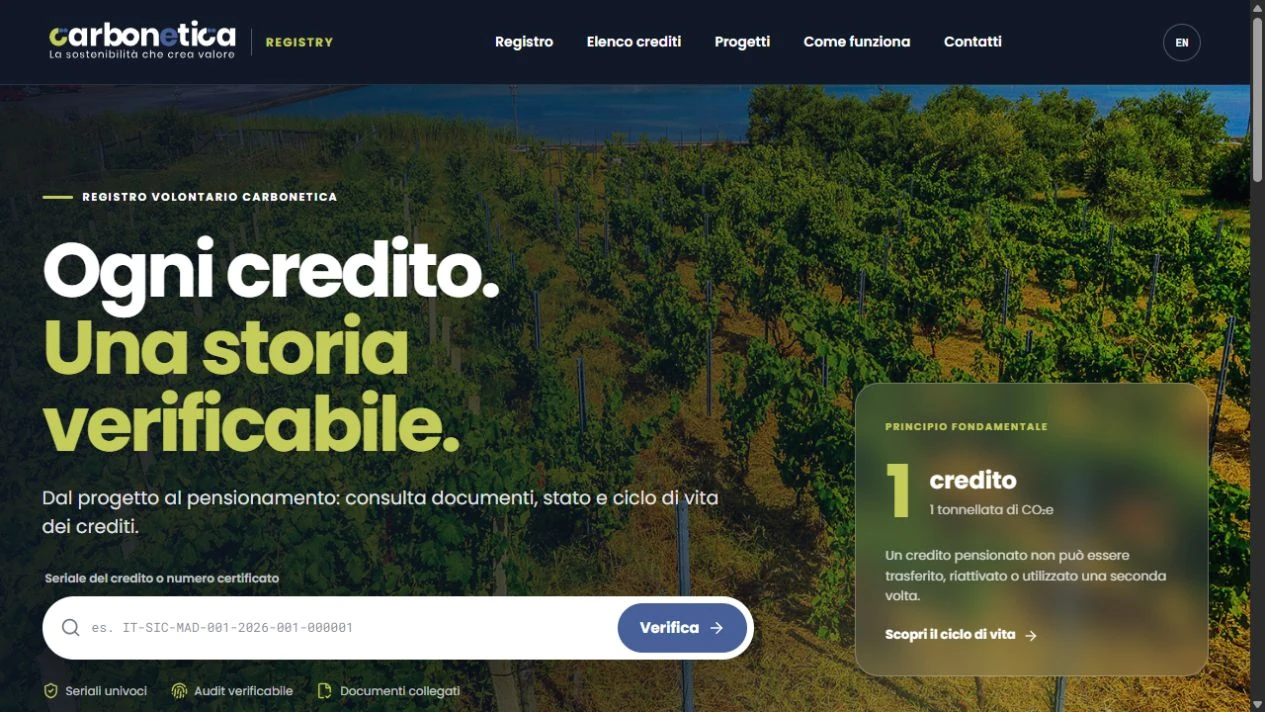
A web portal for a carbon credit registry.
Carbonetica Registry is a bespoke web portal and software project that makes carbon-credit projects, documents and verification information easier to consult.
Where we started.
Carbonetica Registry is a private registry for the voluntary carbon market, not the EU ETS registry. The project needed to make information about locations, projects and credits accessible while preserving links to documents and the rules governing registration. E-ROE built the digital platform; environmental quantification and verification refer to the documents and organisations identified in the registry's project pages.
Why the process needed a bespoke system.
Presenting three projects on a page was not enough. Certified quantities, vintages, batches, serial numbers, holders and document versions needed to stay connected. Public searches, catalogue access and staff operations also required different journeys and permissions. A specific document-based process had to become a data model supported by application controls.
What we did.
- Visual identity and a public portal in Italian and English, with desktop and mobile navigation.
- A data model for projects, organisations, vintages, allocations and batches, linked to public pages and serial numbers.
- Reconciliation rules connecting documentary quantities, certificate totals and whole credits eligible for serialisation.
- Document management by series and version, with public copies, private originals and SHA-256 fingerprints.
- Business software with roles, separate proposals and approvals, queued processing and event records.
- Infrastructure and release procedures with separate TEST/LIVE modes and a rollback path.
A snapshot, not a promise.
Public snapshot verified on 3 September 2026. These figures describe registry quantities and scope, not sales, measured savings or carbon offset by E-ROE. Each serial number represents one whole credit of 1 tCO2e.
Visit the source registryCarbon Credit Madonie, Sicilia 1 and Sicilia 2.
Evidence linked to the project pages: 5, 6 and 4 documents.
4 for Madonie, 4 for Sicilia 1 and 8 for Sicilia 2.
Active in the snapshot; 0 retired. This is not a count of credits sold.
One process, four connected parts.
The value of bespoke software: making a complex process accessible without separating data from the rules and evidence behind it.
From the project location to a single serial number.
The homepage introduces the registry and provides immediate access to credit verification. The Carbon Credit Madonie, Sicilia 1 and Sicilia 2 pages bring together location, methodology, verifier, periods, vintages, batches and documents. The catalogue, accessed through email verification, adds filters and linked details.
- A bilingual portal with journeys designed for smartphones too.
- Public search and a permanent page for each serial number.
- Catalogue filters for serial number, project, vintage and status.
Registry rules become software rules.
The certificate total is the reference: credits are whole units and are not rounded up. For Sicilia 1, 349,350.51 certified tCO2e correspond to 349,350 credits, leaving 0.51 tCO2e unserialised. Allocation across vintages follows the largest-remainder method; Sicilia 2 uses a controlled adjustment to reconcile the sum with the certificate.
- An explicit distinction between documentary, certified and serialisable quantities.
- Vintages and batches linked to their source project.
- An application control requiring a published certificate before issuance.
More than attachments: identifiable evidence over time.
Each public document has a category, series, version, date and SHA-256 fingerprint. The system separates private originals from copies intended for public access and includes watermarking and publication manifests. Project pages give readers the relevant evidence without making them search an undifferentiated archive.
- Document versions linked to the correct project.
- Hashes identifying the specific published copy.
- Separation between confidential material and public documentation.
Different roles, separate decisions, connected events.
The business application implements invitation-only staff accounts, differentiated roles and TOTP two-factor authentication. Operations follow the four-eyes principle: the person proposing an operation cannot approve their own proposal. The software includes issuance, transfer and retirement functions, a queue for bulk processing and an audit log with chained hashes.
- A console for projects, organisations, batches, documents and operations.
- Proposals and approvals assigned to different people.
- Internal capabilities described from the application implementation.
Project images.
Real screenshots from 3 September 2026, cropped to show the features. Open an image to inspect the details.
Public information connected to the process.
- Visitors can move from a project to its supporting evidence, and from a serial number to the credit's origin, holder and lifecycle.
- Quantity and publication rules are represented in the software alongside the relationships between data and documents.
- One platform brings public communication and process management together while keeping access levels distinct.