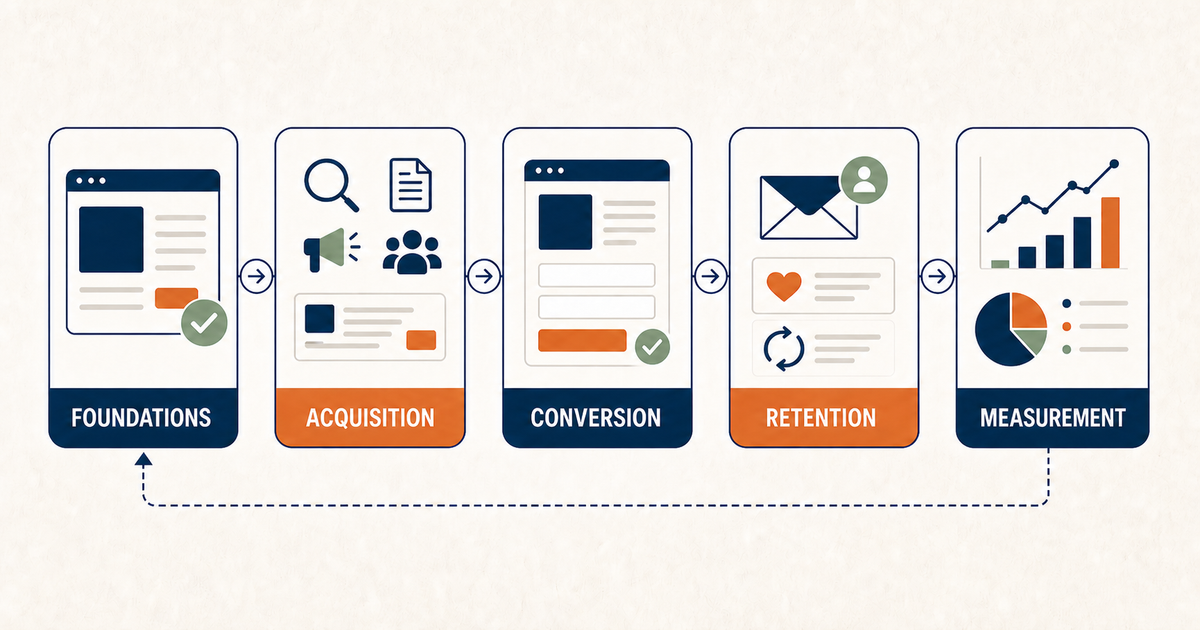
web marketing for an SME* is the system by which the company transforms business objectives into coordinated digital activities. The site clarifies the offer, SEO and campaigns intercept demand, social build continuity and confidence, the email maintains the relationship and measurement helps to decide where to continue investing.
There’s no need to be anywhere. It is necessary to choose a few channels compatible with margins, people, times and ability to manage requests. An effective plan starts from the company result and builds the necessary path.
This guide is not an encyclopaedic definition of digital marketing. It is a decision-making structure for owners and managers who must establish priorities, budgets and controls without letting the site, social, campaigns and emails work separately.
What is web marketing from an SME perspective
For an SME, web marketing means answering five questions:
- What commercial result do we want to support?
- Who needs to make a decision and with what information?
- Where can we reach that person?
- What should happen after the first click?
- What data will tell us if we continue, correct or stop?
The strategy links these steps. Posting, buying traffic or refurbishing the site are activities; they become strategic only when they have a recognizable role in the system.
Start with business goals, not from channels
“We must do Instagram” or “we try Google Ads” are not goals. A useful goal describes the desired change: increasing demands for a service, selling a category, reactivating customers, supporting a new home or reducing the time lost on unrelevant contacts.
Before choosing the channels, clarify:
- priority offer;
- public and geographical area;
- value and margin of sale;
- monthly capacity to serve new customers;
- duration of decision-making;
- materials, tests and content available;
- responsibility between marketing and commercial;
- Time horizon of evaluation.
Too wide target disperses the budget. It is preferable to select a commercial priority and a main metric, with few support indicators.
Customer value, margin and budget sustainability
The budget cannot be decided only by observing how much other companies spend. Two SMEs with the same turnover can have very different margins, frequency of repurchase and operating capacity.
We need at least four sizes:
- margin available on sale;
- average customer value over time;
- percentage of requests that become customer;
- sustainable maximum cost to acquire it.
If a company does not yet know these values, the first job is to create a prudent estimate and improve data collection. Increase traffic before understanding the value of a request can amplify already existing waste.
Consider also the commercial capacity. A campaign can generate contacts, but if no one responds quickly or the quote comes after days, marketing is evaluated on a process that does not entirely control.
The site is the basis of the system
The site is the space where the company controls message, evidence, experience and measurement. It should not contain everything, but must help every audience find the right page and the next step.
A solid base includes:
- comprehensible offer;
- pages dedicated to important decisions;
- verifiable tests;
- mobile experience;
- simple contacts;
- essential speed and accessibility;
- tracking configured with consent;
- domain property, account and data.
The page oncustom store sitesdescribes the role of the site for services and lead generation; for online sale, the reference iscreation and ecommerce management. The channel changes, but the principle remains: the destination must be consistent with the promise that generated the click.
SEO to intercept existing demand
SEO helps to be present when a person expresses a need through research. For an SME it is best to start from service pages, categories and content that respond to real intent.
The work includes structure, indexing, quality of pages, internal links, authoritativeness and measurement. It is not a keyword package and offers no guarantees of first position.
TheSEO E-ROE adviceworks on technical priorities, content and research. In a web marketing strategy, SEO is particularly useful when there is already a question and the company can invest in a heritage of pages to maintain over time.
Social media continuity, trust and content
Social media can show people, methods, jobs, culture and updates with a difficult frequency to get on the site. They are also useful for listening to questions and turning them into deeper content.
Not all SMEs must publish every day or preside over each platform. The choice depends on:
- real presence of the public;
- type of playable content;
- role of trust in the process;
- speed with which products or activities change;
- availability of people to be involved;
- possibility to reuse materials.
Management ofsocial mediashould connect to pages, campaigns and commercial. If the profile generates interest but the site does not explain the offer, the route stops.
Meta Ads and Google Ads: differences and cases of use
Google Ads often intercepts a question already expressed through words and research. Meta Ads can reach public based on interests, signals and behaviors, even before they actively seek a service.
Simplified:
- research is useful when the need is already formulated;
- social advertising can create attention, show a product or reactivate who knows the company;
- both require a consistent page, tracking and a sustainable offer;
- either automatically corrects a confused message or a slow business process.
The sectionadvertising E-ROEdeepens economic thresholds, target pages and measurement. The average budget must be separated from the necessary work by strategy, creativity, management and analysis.
If the channels are already active but do not work together, start from a simple evaluation: goal, destination, measured event and responsibility after contact. Four clear answers are worth more than another open channel without direction.
Email marketing and automation not to lose traffic acquired
SEO, social and campaigns bring people. The email allows you to continue the relationship when there is a valid consent and a reason to return.
An SME can use email to:
- welcome a new member;
- accompany a long evaluation;
- recover a cart or checkout;
- prepare an appointment;
- follow the post-purchase;
- reactivate customers;
- distribute useful content.
Theemail marketingbecomes effective when segments, messages and frequency respond to the real path. Automations can reduce repetitive steps, but must have controls, owners and exception management.
Measurement with GA4, Search Console, CRM and commercial data
Each tool looks at a part of the system:
- Search Console shows organic visibility, queries and pages;
- GA4 records sessions and events configured on the site;
- advertising platforms attribute results according to their models;
- CRM and management show quality, opportunities, sales and margins;
- the commercial team adds the context that the panels do not know.
Digital conversion is not always equivalent to a customer. For this form, phone calls and appointments must be linked, when possible, to the commercial outcome.
Google documentation explains howMark and manage key events in GA4. The technical configuration must be tested: a duplicate event or an unregistered form can lead to wrong decisions.
How to choose channels based on activity
The choice can be ordered with four criteria:
- Question:* People are already looking for service or need to be careful?
- Decision:* buy or compare for weeks?
- ***** What content reduces the perceived risk?
- Economics:** margin and customer value support channel cost?
Then evaluate the production capacity. A video strategy is not sustainable if no one can record; an SEO strategy does not grow if information remains blocked; a campaign does not scale if the company does not manage requests.
Different priorities for four types of SMEs
Local business
The frequent priorities are Google tab, local service page, reviews, mobile contacts and call or appointment measurement. Local campaigns can support services with clear demand.
Professional
We need understandable positioning, pages for the main problems, authoritativeness, content and a contact path that is compatible with industry times and rules.
Company B2B
They count decision-making roles, solution pages, application cases, in-depth materials, CRM and follow-up. The cycle can be long: measure only immediate leads penalizes content that prepare the sale.
The Metis project shows how site, local SEO, social, campaigns and internal organization can be designed as an ecosystem, with different functions but a common direction.
Ecommerce
Catalogue, margins, cards, checkouts, campaigns, emails and repurchase must be read together. The projectHomeis a public example of path that connects Shopify, content, SEO, advertising and Klaviyo without reducing growth to one channel.
How to distribute the budget without arbitrary percentages
There is no universal distribution between site, SEO, social, Ads and email. Instead, start with constraints and priorities.
Separate at least:
- Food: pages, tracking, tools and materials;
- production:* texts, photos, videos, creativity and offers;
- distribution: average investment and partnership;
- *management: persons, agency, software and coordination;
- ** learning:*** testing, analysis and corrections.
The test budget must be long enough and consistent enough to produce an interpretable signal, but prudent enough not to jeopardize the operation. Define first the threshold that would continue, correct or stop the activity.
An SME with a weak site can initially allocate more resources to the foundations. A company with solid pages but little traffic can invest more in distribution. An ecommerce with many visitors and low repurchase can give priority to conversion and retention.
Operating plan of the first 90 days
Days 1-30: foundation and data
- Define target, offer and priority audience.
- Collect margin, customer value and commercial capacity.
- Check pages, messages and contacts from mobile.
- Configure or control events and consent.
- Map existing channels, costs and responsibilities.
- Choose one main hypothesis to test.
Days 31-60: controlled activation
- Publish or improve the target page.
- Prepare few consistent content and creativity.
- Start one or two channels, not all.
- Budget document, public, message and date of changes.
- Manually check form, call and sales quality.
- Fix technical errors before you increase your shopping.
Days 61-90: learning and choice
- Compare cost, volume and demand quality.
- Analyzes drop-off points and recurring questions.
- Keep what produces consistent signals.
- Reduce or change what has a disproportionate hypothesis.
- Turn business questions into pages, emails or content.
- Plan the next quarter with a new priority only if sustainable.
Ninety days do not guarantee a definitive result. However, they offer a fairly structured period to stop deciding on the basis of individual weeks.
Metrics really useful
The main metrics should approach the economic result:
- qualified requests;
- events held;
- opportunities created;
- sales and margin;
- acquisition cost;
- conversion rate per phase;
- average value and repurchase;
- commercial response time.
Impressions, coverage, followers, openings and clicks remain useful to diagnose. They should not be presented as a success when contacts, sales or learning are lacking.
Frequently Errors
Start from everything
Multiply costs, tools and variables. If the results change, you don’t know what intervention I’ve contributed.
Change strategy too soon
Some channels require time, data and content. Correcting is necessary, but pursuing each swing prevents learning.
Measure only followers and clicks
They’re intermediate signals. They must be linked to pages, actions and commercial results.
Transcuring after-contact
The quality of marketing also depends on response, sales and service. A forgotten lead in the form is not a acquisition problem.
Use the same message anywhere
High-intention research, social content and reactivation email require different contexts while maintaining the same basic promise.
Final checklist
- Priority target and offer are written.
- Margin, customer value and capacity are estimated.
- The site explains the decision and measures.
- Each channel has a role and a manager.
- The budget separates foundations, production, distribution and management.
- The campaigns have thresholds of continuation or stop.
- Social and content are sustainable for the team.
- Emails and automations respect consent and real path.
- CRM and business data complete digital panels.
- The revision takes place on a coherent period.
Frequently asked questions
Which channel should an SME start?
Depends on demand, sales cycle, margin, served area and available materials. First you clarify offer, target page and measurement; then you choose the channel that can produce the most useful signal.
How much budget is it for web marketing?
There is no universal percentage. The budget must be sustainable compared to margin, customer value, commercial capacity, production cost and time needed to collect sufficient data.
SEO or Google Ads: what is it?
SEO builds organic visibility over time; Google Ads can intercept demand more quickly until the investment is active. The choice depends on urgency, competition, economics and quality of the pages.
Are social media indispensable for all SMEs?
No. They are useful when public, content and frequency are sustainable. For some activities they count mainly trust and continuity; for other research, partnership or direct sale they have greater priority.
What metrics should an SME follow?
Qualified requests, appointments, sales, margin, conversion rate, acquisition cost and value over time. Cover, follower and click help diagnose, but do not replace commercial results.
Build the first version of the system
For an initial assessment, use thepage contactsand describe objective, public, active channels and main perceived limit. The first step is not to add another activity: it is to decide which part of the system must be made clearer, measurable or sustainable.