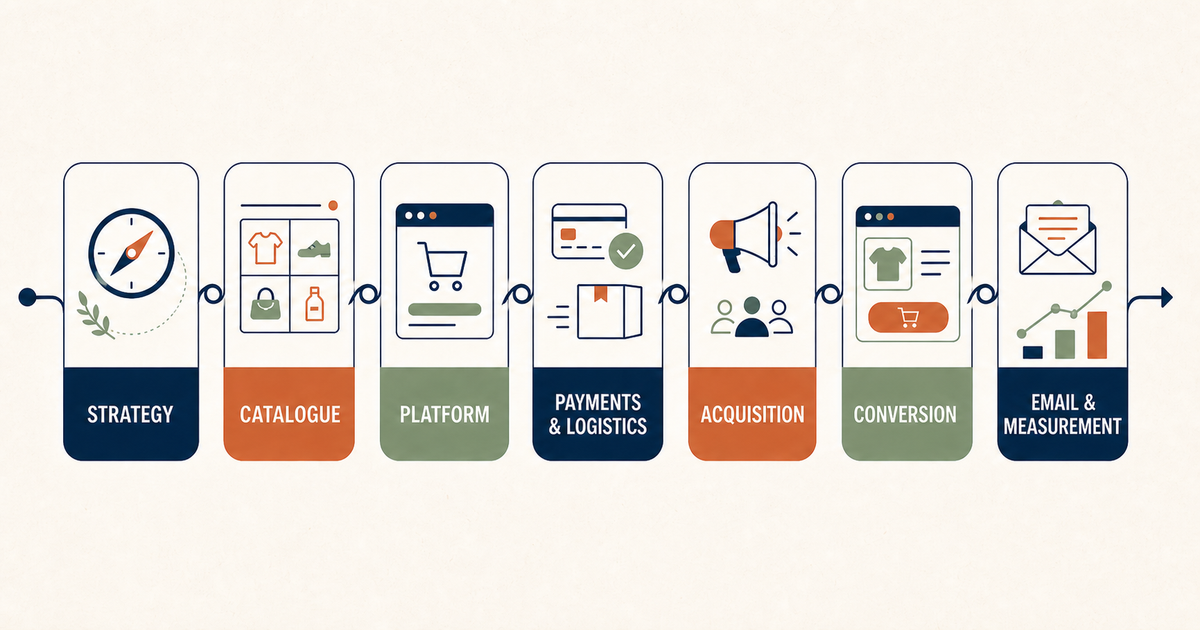

Opening an ecommerce is a project. Managing it is a continuous work. Catalogue, product pages, campaigns, emails, SEO, promotions and data change every week and must remain aligned. When no one really has the responsibility of the system, the shop continues to exist but stops improving.
For this reason many SMEs evaluate the ecommerce management in outsourcing: entrust to an external partner a part of the activities and coordination, keeping in the company product, commercial decisions and skills that do not need to delegate.
Let’s see what the service can understand, what models exist and how to understand if it is the right choice.
Managing an ecommerce does not only mean updating the catalog
The word management is used for very different services. Some suppliers deal with orders, logistics and customer care. Others work on platform, content and marketing. Others still coordinate the entire sales channel.
Before requesting a quote you must then separate the areas. For E-ROE theecommerce managementcan understand:
-
maintenance and improvement of Shopify or existing platform;
-
home, categories, product cards and purchase path;
-
promotional plan and content update;
-
Meta Ads,Google Adsand Google Shopping;
-
SEO, blogs and category pages;
-
automation and integration between instruments;
-
reports with priorities and decisions for the next period.
Warehouse, order preparation, shipments, returns, invoicing and customer service may remain internal or be entrusted to logistic partners. The important thing is to define who answers every step.
A concrete example is the ArredoCasa project, where shop, content, advertising, email and SEO work as a single system.
To compare proposals, use the responsibility table below alongside the scope of the ecommerce management service. The ArredoCasa case study shows how the areas of work connect. Your quote needs to reflect your catalogue and the activities your team can manage internally.
The four areas that need to work together
1. Platform and purchase route
The store must be fast, readable by mobile and easy to navigate. Management includes menu controls, search, filters, availability, variants, payments, shipments and checkout. Each change must be evaluated according to the impact on the customer and on the internal work.
2. Catalogue and contents
Titles, photographs, descriptions, attributes, categories and collections influence both conversion and visibility. An updated catalogue creates doubts, returns and ineffective campaigns. The priority is not to write more, but to make clear the information you need to buy.
3. Acquisition and Report
Campaigns, SEO, newsletters and automations are not separate channels. Campaigns bring people to the shop, pages have to convince them, emails recover who does not buy immediately and SEO builds demand over time. Ecommerce management serves to choose the order of activities and maintain consistent messages and offers.
4. Data and priorities
A useful report does not only list turnover and traffic. It must indicate where you lose value: categories without visits, pages produced with a lot of traffic and a few carts, abandoned checkouts, non-profit campaigns, customers who do not regain or email ever activated.
What can be delegated and what must remain in the company
| Activities | Delegation | To be held internally | Quote factors |
|---|---|---|---|
| Development and UX | Changes, tests, mobile control | Technical vines and operational priorities | Number of templates, integrations and testing frequency |
| Catalogue | Loading, optimization, organization | Prices, margins, availability and product | Number of products, variants and updates |
| Marketing | Campaigns, emails, SEO, content | Budget, promotions and positioning | Channels, markets and campaign frequency |
| Data | Dashboard, analysis and recommendations | Commercial decisions and sustainability | Data sources to connect and reporting frequency |
| Operations | Possible with dedicated partners | Quality, SLA, returns and customer relationship | Order volume and agreed scope of support and returns |
Outsourcing works when the partner receives data, accesses and decisions in reasonable time. It cannot compensate for unknown margins, unreliable stocks or decided promotions without coordination.
When it is best to outsource ecommerce management
-
The shop already sells, but the activities depend on different people without a common priority.
-
The owner takes all operational decisions and can no longer follow growth and product.
-
Campaigns, emails and sites are managed by suppliers who do not share data and calendar.
-
The catalogue often changes and pages are not updated.
-
There are no internal skills for Shopify, advertising, SEO or Klaviyo.
-
The company wants to test an external team before hiring more figures.
-
There are traffic and orders, but not a continuous process of analysis and improvement.
When you need it first
External management is not the first solution if the product is not validated, the margins are not clear, the catalog does not have a manager or the company cannot evade orders reliably. In these cases it is best to start with an audit and a limited roadmap.
Before activating a continuous management should be known at least:
-
gross margin by category or product;
-
reassociation times and stock levels;
-
shipping costs, returns and payment;
-
sustainable budget marketing;
-
average order value and repurchase rate;
-
realistic goals for the next six or twelve months;
-
internal people responsible for product, administration and logistics.
How much does an ecommerce cost
There is no valid fare for everyone. The cost depends on the number of delegated activities, the catalogue, the markets, the frequency of campaigns, the production of content, the integrations and the level of assistance required.
The most common models are:
-
fixed monthly fee, suitable for a defined continuous perimeter;
-
package of days or hours, useful when priorities change often;
-
initial project more management, to first settle the base and then improve it;
-
canon more variable on results, possible only with very clear data, margins and responsibilities;
-
separate services, for example only email, SEO or advertising, when coordination remains internal.
To compare two proposals, always ask what channels are included, how many activities are produced, who implements the changes, what tools are excluded and how often decisions are made.
How should start an outsourcing management
Start publishing campaigns or remaking graphics is risky. An ordered entrance should follow four stages.
-
Initial analysis: accesses, data, catalog, tracking, campaigns, emails, SEO, platform and internal processes.
-
Choice of priorities: few measures, sorted by impact, urgency and dependencies.
-
Top 90 days: activities, managers, deadlines, budgets and indicators.
-
Improvement cycle: publish, control data, correct and decide the next period.
The KPIs to control
The turnover is the final result, but alone does not explain what is working. The set of indicators must connect demand, conversion, margin and relationship.
-
Qualified sessions per channel and category;
-
added rate to the cart and checkout start;
-
conversion rate, separated by device and source;
-
average order value;
-
cost of acquisition and return on advertising spending;
-
margin after discounts, shipments and variable costs;
-
revenues from automatic emails and newsletters;
-
share of customers recovering;
-
returns, cancellations and requests for assistance;
-
speed and availability of the main pages.
Not all KPIs need to improve at the same time. Management also serves to decide which leverage has priority at a given time.
Questions to ask a potential partner
-
What activities will you manage directly and what will remain to us?
-
Who will be responsible for the project?
-
How do you choose priorities between site, campaigns, emails and SEO?
-
What accesses and data do you need?
-
How do you consider margins, stocks and operational capabilities?
-
Which deliverables are included every month?
-
How are promotions and content approved?
-
What indicators will you use in the report?
-
How long does the internal team take?
-
How does management stop or move?
The real advantage of outsourcing
The advantage is not to stop dealing with ecommerce. It is to prevent each channel being managed as a separate project and having a method to decide what to do before. The company maintains product, margins and commercial direction; the partner translates these decisions into pages, campaigns, emails, content and controls.
When responsibility, data and priorities are clear, an external team can speed up work and reduce the cost of coordinating many different skills. When missing, it adds only new meetings.
Next step:* if your shop is already online but you do not know if to intervene on product pages, campaigns, emails, SEO or automations, start with a complete check. E-ROE analyzes the system and orders priorities before proposing continuous management.
Frequently asked questions
What does an ecommerce management service include?
It depends on the contract. It can include platform, catalog, UX, campaigns, emails, SEO, content, automations and reports. Logistics and customer care must be indicated separately.
How much does it cost to manage an outsourcing ecommerce?
The cost varies according to catalogue, markets, channels, frequency of activities, integrations and level of responsibility. It needs a detailed perimeter to compare the proposals.
Can I only outsource marketing and email?
Yes. Outsourcing can be complete or partial. The best choice depends on the internal skills and who maintains overall coordination.
Is ecommerce management only suitable for Shopify?
No. The method can be applied to multiple platforms, although tools and operating modes change. The technical quality of the existing shop must be verified first.
Need an internal ecommerce manager?
Not always. In smaller SMEs, the role can be shared between an internal contact person and an external partner. With the growth of catalog, markets and teams, a dedicated internal responsibility becomes more useful.