
*realization of an ecommerce at Piacenza is not only about publishing a catalogue and linking a payment method. For a company or SMEs it means designing a new business process: products must be found, understood, purchased, paid, shipped and assisted continuously.
Technology is important, but comes after some more concrete decisions. What products have sufficient margin? Who will update prices and availability? How will returns and requests be managed? Where’s the traffic coming from? What data will they say if the project is working?
This guide helps to prepare the project and compare the proposals of a web agency, developer or ecommerce partner without reducing everything to the choice of the platform.
What includes the realization of a professional ecommerce
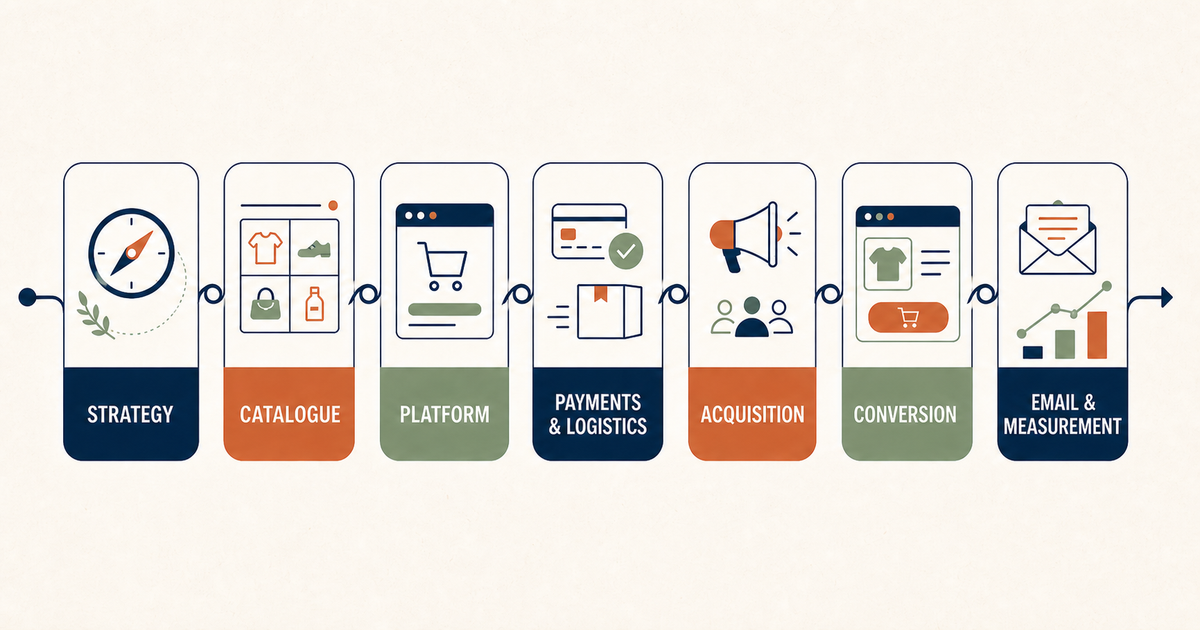
A complete project coordinates at least seven areas:
- commercial strategy and catalog priority;
- architecture of categories, products, variants and filters;
- mobile experience, product cards, cart and checkout;
- payments, shipments, taxes, returns and communications;
- integrations with management, CRM, email and other tools;
- SEO, content, campaigns and acquisition plan;
- tracking, testing, training and management after launch.
It is not necessary that only one supplier carry everything. But it is necessary to know who is responsible for every passage. Not assigned activities tend to emerge late, when blocking the import of the catalogue or publication.
The guide oncosts, times and content of an ecommerce projectdeepens the perimeter of a quote. Here we focus on the decision of a company looking for an ecommerce partner in Piacenza.
When it makes sense to invest in an ecommerce
An online store can expand the market beyond the point of sale and make a catalog purchaseable without depending on schedule. However, it is not the right choice for any activity or phase.
Before you start, check:
- **Does there exist people willing to search or discover these products online?
- Margin:* after product, payment, shipping, returns and acquisition remains a sustainable margin?
- Catalogue: data, photos, prices, variants and availability are quite sorted?
- **Operation:**Can anyone handle orders, exceptions and assistance with clear times?
- Acquisition: is there a real budget or capacity for SEO, campaigns, content, partnerships or customers already active?
- Measurement:* orders, costs and sources can be read together?
If one of these areas is still uncertain, it does not mean that the project should stop. It means that the first phase must reduce uncertainty with a pilot catalogue, margin analysis or a limited launch.
The advantage of a close partner is not only the distance
For a Piacenza company, working with an interlocutor who knows the local context can make comparison with owners, administrative staff, warehouse and point of sale easier. The real value, however, is not to meet in person: it is to be able to connect commercial decisions and technical work.
An ecommerce born in Piacenza can sell throughout Italia or abroad. Delivery area, languages, currencies, taxation, assistance and logistics must therefore reflect the target market, not the supplier’s location.
Evaluate the partner by method, responsibility and ability to integrate the store with daily work. Proximity is useful when accelerating decisions and collecting materials; it does not replace skills and process.
Parts from catalog and processes, not from the graphic theme
The catalogue is the commercial structure of the site. Before design, they serve consistent rules for:
- categories and collections;
- names, codes and variants;
- attributes used in filters;
- prices, promotions and availability;
- pictures and descriptions;
- exhausted or replaced products;
- delivery times and return conditions.
A sample of ten or twenty products is often more useful than an incomplete sheet with hundreds of rows. It allows you to try import, card, variant, search, filters and order before climbing the job.
If the catalog already lives in a management, it should be clarified which system controls prices, stocks and graphics. Manually copying the same data into multiple tools creates errors and makes growth fragile.
Shopify, WooCommerce or custom development
There is no better platform at all. There is a solution more suitable for project requirements, skills and constraints.
Shopify may reduce part of technical management and offer a broad ecosystem. WooCommerce may be suitable when WordPress is already central and the team knows that context well. A custom development* makes sense when processes, configurations or integrations cannot be handled well with standard solutions.
Before choosing, compare:
- initial and recurrent costs;
- necessary applications or plugins;
- team autonomy;
- performance and maintenance;
- quality of integrations;
- data portability and content;
- limits on markets, lists and trade rules;
- cost of changing solution in the future.
development of ecommerce websites must follow the requirements. Choose the platform first and adapt after the business process can turn each exception into an additional application or a manual step.
Product maps, mobile and checkout
An effective card reduces the doubts needed to choose. It must make visible features, benefits, variants, availability, delivery, returns and evidence relevant to that product.
From mobile check at least:
- readability and hierarchy of information;
- selection of variants and quantities;
- loading speed;
- filters and search;
- clarity of costs;
- compilation of addresses;
- payments and error messages;
- order confirmation.
Checkout must be tried with real test orders: accepted payment, refused, cancelled and refunded. Also notifications, stocks and customer data must arrive in the correct systems.
Integrations and automations to design before launch
An ecommerce rarely works alone. You may need to communicate with management, billing, couriers, CRM, email platform, assistance and advertising tools.
For each connection you define:
- which system is the main source of data;
- which event starts the flow;
- which fields are transferred;
- how to handle duplicates and errors;
- who receives alerts;
- which steps require human approval.
Not everything must be automated immediately. It should start with repeat, frequent and stable passages. The page onautomation for companies and ecommercedescribes how to connect tools without eliminating important controls.
SEO to intercept useful searches
The SEO of an online store does not solve with the product name in the title. We need a readable structure, consistent categories, original content, internal links, correct structured data and management of duplicate or unneeded pages.
Before launch, they must be checked:
- URL and hierarchy of categories and products;
- title, description and heading;
- canonical, filters and parameters;
- sitemap and indexing;
- redirect in case of migration;
- mobile performance and usability;
- availability of exhausted products and pages.
For local queries such as “ecommerce Piacenza” or “ecommerce sites Piacenza” it is useful to explain area served, method and relevant cases. The pages should not repeat the location artificially: they must help a local company make a better decision.
How to bring traffic after publication
Posting does not automatically ask. The initial plan can use SEO, Google Ads, Meta Ads, email, content, partnership or existing customers, but must assign a role to each channel.
Before investing in traffic, check that the target page, catalog and tracking are ready. A campaign can speed up learning, but also boosts price, message or checkout problems.
For a shop already active, thecheck-up ecommercehelps order product, mobile, checkout, acquisition, email and data.
What factors determine costs and times
The cost of an ecommerce in Piacenza does not depend only on the number of pages. The main variables are:
- quantity and quality of catalogue data;
- design and custom components;
- photographs, texts and translations;
- migration from other systems;
- integrations and automations;
- markets, currencies and lists;
- configuration of payments and shipments;
- tests, training and assistance;
- necessary activities for launch.
Times also depend on customer deliveries. Catalogue, access, commercial rules and approvals must appear in the calendar along with the provider’s activities.
Ask for a quote that separate initial investment, licenses or fees, maintenance, marketing and optional activities. Only so two proposals become comparable.
How to choose an ecommerce agency in Piacenza
During the comparison, ask:
- What results and processes will be analyzed before design?
- Who prepares and valid catalog, texts and photographs?
- What integrations are included and how are tested?
- What SEO and tracking activities are part of the launch?
- Who controls test orders, refunds and notifications?
- Will account, domain and data remain accessible to the company?
- What recurring costs are expected?
- How are changes, assistance and developments managed?
- What activities will it take to bring traffic?
- What conditions should be met before publication?
Portfolio and case studies are useful, but must be read together with the process. The projectAboutshows, for example, the role of migration, redirect and operational continuity;Homeshows the link between catalog, Shopify, content, campaigns, email and SEO.
Checklist before requesting a quote
- Objective and priority market are clear.
- Products and initial margins were selected.
- There is a complete sample of the catalogue.
- Payments, shipments and returns have defined rules.
- The tools to integrate are known.
- The team knows who will manage orders and content.
- A plan is planned to acquire traffic.
- Tracking and indicators are included in the project.
- Initial and recurring costs may be compared.
- The launch includes test orders and acceptance criteria.
Frequently asked questions
How much does an ecommerce cost to Piacenza?
The cost depends on catalog, design, platform, data, integrations, content, migration and launch activities. A useful estimate separates initial investment, recurring costs and subsequent services.
How long does it take to create an ecommerce site?
The times depend mainly on catalog, materials, commercial rules, integrations and approval speeds. The calendar must include customer activities, tests and corrections, not only technical development.
Better Shopify, WooCommerce or a custom solution?
It depends on catalog, processes, internal skills, integrations and level of customization. The platform must be chosen after clarifying total requirements and costs, not as a first step.
Can a local ecommerce sell throughout Italia?
Yes. Having a partner at Piacenza can facilitate comparison and operation, but market, logistics, payments, assistance and acquisition are designed for the area where you really want to sell.
Are SEO and campaigns included in the realization?
Not automatically. Technical base, tracking and SEO requirements should be defined before launch; continuous content and campaigns require responsibility, budgets and separate objectives.
Next step
Thecreation and ecommerce management E-ROEpart from catalog, processes, margins and tools already present. If you are evaluating a new shop or remaking of the current one, bring a sample of the catalog and the necessary integrations: the first useful result is a clear perimeter, not a chosen platform too soon.