
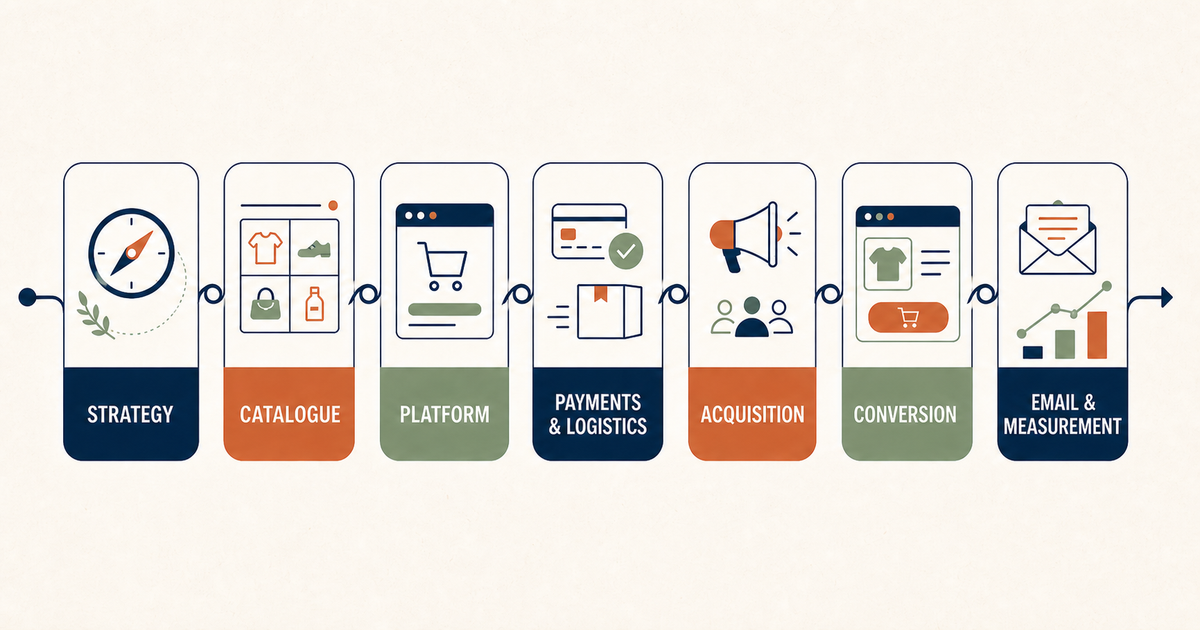
The creation of a professional ecommerce** includes much more than the configuration of a platform and the loading of products. The project must connect offer, catalog, mobile experience, payments, logistics, data, SEO, email and acquisition. It must also clarify who makes decisions, who prepares materials and who will manage the shop after the launch.
To evaluate a quote is not enough to ask “how much does the site cost? ”. It is necessary to understand what activities are included, which remain to the customer, what costs will continue over time and with what criteria the work will be considered.
This guide has a decision-making cut. If you are still defining products, public and feasibility, start first fromchecklist to create an ecommerce from scratch. Here instead we see how to read a professional proposal and turn it into a controllable project.
What really includes creating an ecommerce
A complete realization should cover at least five areas:
- strategy, to define offer, public, margins and objectives;
- ** experience**, to organize catalog, navigation, cards and checkouts;
- ** operation** to manage payments, shipments, taxes, returns and assistance;
- ** acquisition and relationship***, to bring traffic and not lose those who do not purchase immediately;
- measuring, to check events, orders, sources and commercial results.
Not all suppliers run every area. It is legitimate, provided the border is explicit. A quote can entrust photographs, texts or campaigns to the customer or to other partners; the problem arises when these dependencies emerge only from the project started.
Why not simply load products
The product online must be found, understood, compared, purchased, paid, shipped and possibly returned. Each step contains technical and commercial decisions.
Charging one hundred incomplete tabs does not build a useful catalog. Connect a payment without proof of refunds and notifications does not complete the checkout. Publish the shop without a traffic plan does not start a sales channel.
The most important work is often done before development: data cleaning, catalog priority, business rules, internal responsibility and content collection. If these bases are fragile, the platform amplifies disorder.
Preliminary analysis: offering, margins, public and processes
Before choosing the theme or technology you need to check that the model can work. The initial analysis should answer concrete questions:
- which products have sufficient demand and margin;
- which categories deserve the initial launch;
- who is the customer and what doubts slow the choice;
- as they affect shipment, returns, commissions and assistance;
- who updates availability, orders and promotions;
- which markets, languages and currencies are really priority;
- how the first qualified traffic will be acquired.
This phase does not only produce a document. It must turn into decisions: initial assortment, structure, indispensable features, deferable activities and indicators to monitor.
Catalogue, categories, variants, filters and search
The catalogue is the commercial architecture of the shop. Products, variants and attributes must be consistent before importation.
A professional project clarifies:
- taxonomy of categories and collections;
- rules for titles, codes, variants and availability;
- filters that really help selection;
- internal research behaviour;
- exhausted and alternative products;
- necessary data in the cards;
- responsibility for images, descriptions and translations.
The number of products, alone, says little. Fifty articles with many combinations, incomplete data and photographs to produce can require more work than a large catalog already ordered in a management.
Design, mobile and shopping route
Design must support the way people choose. It is not a decoration applied at the end.
Navigation, filters, legibility, selection of variants, buttons, modules and cart summary should be checked. The product boards serve hierarchy, priority information, delivery times, returns, evidence and answers to doubts.
The estimate should distinguish between configured theme, graphical adaptation and custom developed components. It should also indicate how many proposals and revisions are included on which devices the tests are performed and what elements are delivered to the team.
Payments, shipments, taxes, returns and communications
These activities link the site to everyday activity. For each payment method, a positive outcome, refusal, cancellation and refund must be proved. For shipments it is necessary to define zones, thresholds, times, exceptions and tracking.
The project should specify who configures and validates:
- methods and currencies of payment;
- rates and tax rules with the support of the competent consultants;
- rates, shipping areas and thresholds;
- incorrect or incomplete addresses;
- returns, changes and refunds;
- Transactional emails;
- availability and synchronization of the warehouse;
- assistance before and after purchase.
Commercial conditions must be readable before checkout. Hiding costs or times until the last step increases friction and requests to support.
Want to check out an online shop? Thecheck-up ecommerceorder product, mobile, checkout, acquisition, email and data.
Tracking, GA4, Search Console and Event Testing
The measurement should be designed before publication. The minimum useful includes product display, added to cart, checkout start and purchase, with currency and correct value.
It is not enough to see the event in a panel: it serves test orders and a comparison with the platform data. Duplications, consents, payment referrals and differences between recorded revenues must be checked.
Search Console helps to observe indexing, queries and organic pages. GA4 shows routes and events on the site. The ecommerce platform remains the operational reference for orders and refunds. The estimate must indicate tools, account properties and checks included.
Initial SEO, redirect and indexing
The initial SEO does not mean promising positions. It means avoiding predictable obstacles and building a legible base.
Before launch, they must be verified:
- Product URLs, categories and content;
- title, description and heading principal;
- canonical and duplicate pages;
- sitemap and indexing rules;
- internal connections;
- structured data consistent with visible information;
- mobile performance and usability;
- redirect, especially during a migration.
The projectAboutshows why, in a passage from WooCommerce to Shopify, mapping URL and redirect is part of the realization and not an optional control of the last day.
Newsletter, automation and recovery of abandonment
Most people don’t buy at the first visit. For this collection of consents, segmentation and emails should be considered in the overall system.
A base may include welcome, cart recovery or checkout and post-purchase communications. Each flow requires triggers, exclusions, frequency, content, consent control and measurement.
The guide onemail marketing for ecommerceexplains the role of the different flow;cart and abandoned checkoutinstead distinguishes two intentions that should not be treated with the same message.
Campaigns and plan to bring traffic after launch
A published ecommerce does not automatically generate demand. The project should arrive at the launch with an initial choice of channels, consistent target pages, available materials and a sustainable testing budget.
SEO, Google Ads, Meta Ads, partner and email address different needs. It is not necessary to activate them all. It is necessary to decide which ones can reach the public at which stage and with which economic threshold.
The projectHomethe construction of the shop has been connected to catalog, content, campaigns, Klaviyo and SEO.The Weight of Wordsinstead shows how product, philosophy, community and sale can become a single route. They are public examples of coordinated systems, not replicable formulas without analysis.
What factors affect costs
E-ROE does not publish a single price for making a shop, because the perimeter can change radically. The voices that affect the most are:
- quantity and quality of catalogue data;
- design and customization;
- content, photographs and translations;
- migration from other systems;
- integrations with management, couriers, CRM or marketplace;
- markets, currencies, lists and tax rules;
- external automation and tools;
- tests, training and assistance;
- later acquisition and optimization.
A generic band, without this information, is likely to be misleading. Better to ask for a quote based on explicit hypotheses and comparable scenarios.
Realistic times and customer dependencies
The duration depends not only on development. Catalogue, texts, photographs, commercial rules and approvals can determine the critical path.
A serious calendar indicates:
- what must deliver the customer and when;
- which decisions block the next steps;
- how many revisions are expected;
- when imports and integrations take place;
- who participates in the tests;
- which conditions allow publication.
A promised date without dependencies is not a plan. It is useful to predict margin for missing data, corrections and a controlled launch with real orders.
What should contain a professional quote
The quote should allow another person to understand what will be delivered. Search at least:
- objectives and perimeter;
- platform and environments;
- deliverables for each stage;
- Indicative quantity of pages, products or templates;
- business of the supplier and the customer;
- integrations included;
- test plan and acceptance criteria;
- training, documentation and assistance;
- domain property, account, data and code;
- exclusions and management of additional requests;
- initial costs, renewals and optional services;
- times, payments and withdrawal conditions.
A precise description protects both parties and reduces discussions on activities given for granted.
Initial costs and recurrent costs
The initial investment covers analysis, design, configuration, development, content, migration, testing and launch. Recurring costs may include platform or hosting, domain, applications, maintenance, service, commissions, email tools, content and marketing.
Ask for a projection based on current use and growth scenario. Some tools increase with orders, contacts, traffic or functionality. Evaluating the total cost over time is more useful than comparing only the first invoice.
Errors to avoid when choosing only according to the price
The lowest price is not necessarily wrong and the highest price does not guarantee quality. The risk arises when comparing different perimeters as if they were equivalent.
Avoid:
- choose before having a sample catalog;
- give for including photographs, texts, SEO or campaigns;
- ignore renewals and commissions;
- accept integrations described without specification;
- publish without test orders;
- leave accounts and data in accordance with the provider;
- invest everything in development without resources for traffic and management.
Final checklist before accepting
- Objectives, public and priority catalogue are clear.
- Deliverable and exclusions are written.
- Customer responsibility has realistic dates.
- Mobile design and checkout are included in the tests.
- Payments, shipments, returns and emails are tested.
- Tracking, initial SEO and redirect have a manager.
- Acquisition plan and automation are not left to chance.
- Initial and recurring costs are separated.
- Access, data and property remain controllable by the company.
- The launch includes verification and assistance.
Frequently asked questions
What does it include creating a professional ecommerce?
It includes at least analysis, catalog architecture, responsive design, technical configuration, payments, shipments, content, tracking, initial SEO, testing, training and launch plan. The precise perimeter must be written in the quote.
How much does it cost to create an ecommerce?
There is no valid figure for everyone. The cost depends on catalogue, available data, design, platform, markets, integrations, content and operational responsibilities. The estimate must separate initial investment and recurring costs.
How long does it take to make an ecommerce?
The times depend mainly on decisions, catalogue, materials, integrations and tests. A realistic calendar indicates customer deliveries, revisions, dependencies and acceptance criteria, not only a final date.
SEO, email marketing and campaigns are included?
Not automatically. An SEO base and tracking should be expected before launch; continuous content, advanced automations and campaigns require a distinct perimeter and budget.
How do you compare two ecommerce quotes?
Proposals on the same list of deliverables, responsibilities, exclusions, recurring costs, assistance and access ownership. Compare only the total can hide essential activities not included.
Next step
Thecreation and ecommerce management E-ROEpart of the real situation: catalog, processes, tools, traffic and responsibility. If you are evaluating a proposal, quote and available materials: the first goal is to understand what is missing, what can be postponed and what decisions should be made before developing.