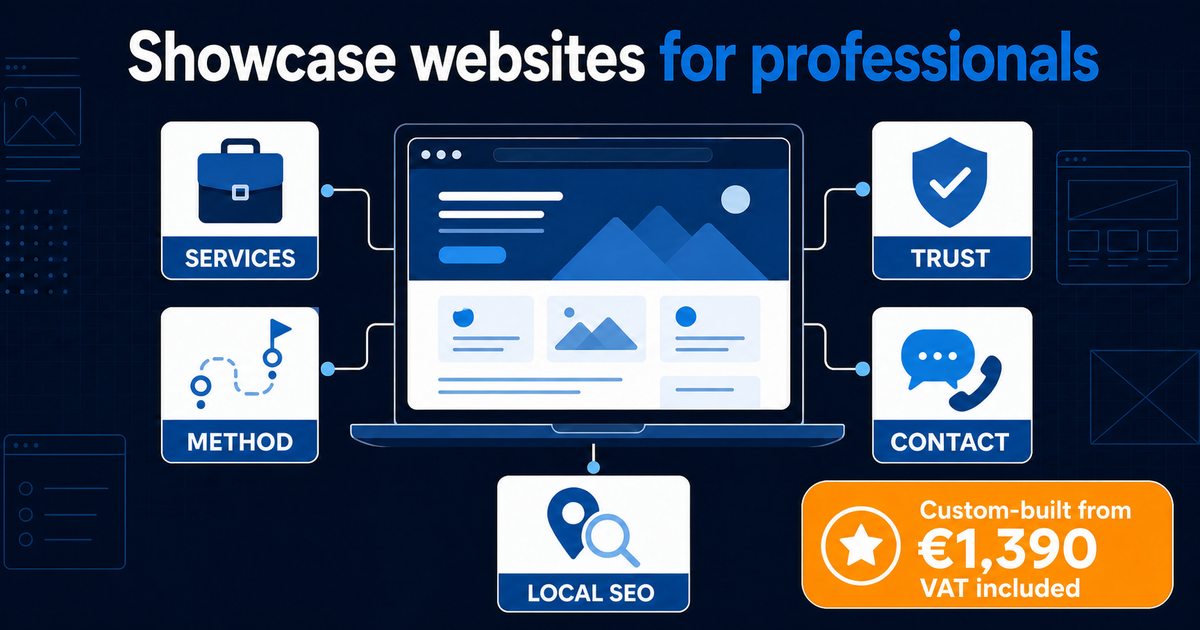
A showcase website for professionals should not be a simple resume transferred online. It has to help someone who doesn’t know you quickly understand who you are, what problems you can help her solve and how to contact you.
This applies to psychologists, accountants, lawyers, consultants, doctors, dentists, architects, personal trainers and for anyone who sells a professional expertise instead of a standard product.
Before choosing a professional, people seek information, compare alternatives, read reviews and try to figure out if they can trust. A well built site organizes all these answers in a stable and controlled place directly from you.
In this guide we will see what must contain a showcase website for professionals, what pages are really necessary, how much it costs to realize it and how to transform it into a tool capable of generating contact requests.
Do you want to see how your site might be?
E-ROE prepares a first concrete and navigable proposal. You value it before you decide to publish it and pay it.
♪ style="display: inline-block; margin-top: 10px; padding: 14px 27px; background-color: #111827; color: #ffffffff; text-decoration: none; border-radius: 6px; font-weight: 700;"> Discover the showcase websites for professionalsWhat is a showcase website for professionals?
A showcase website is a site designed to present an activity and generate contacts, without necessarily selling products directly online.
In the case of a professional, the site must explain:
- who are you;
- what you do;
- to whom you turn;
- which services you offer;
- as works;
- for a person should trust you;
- where you receive or in which areas you operate;
- how to request a first contact.
His goal is not only “make you find online”. It has to help the visitor understand if you are the professional suitable for his need.
To deepen the function of this type of site you can also read the guide on*what is a showcase website and why it serves an activity *.
Why does a professional still need a site?
Many professionals work with word-of-mouth, LinkedIn, Instagram or their Google card. They are important channels, but do not completely replace a site.
When a person receives your name from an acquaintance, often the first thing he does is look for you online. She wants to confirm what she was told and understand something more before calling you.
If you find only an unregistered social profile or a tab with little information, you may not be able to understand:
- if you take care of its specific problem;
- which approach you use;
- if you work with private individuals or companies;
- if you receive online or in the studio;
- as the first appointment takes place;
- which channel to use to contact you.
The site becomes the point where all this information is ordered and presented with the right tone.
Instagram and wording can bring interest. The site helps transform that interest into trust and contact. You can deepen the difference in the article**I already have Instagram and speak: do I need a showcase website? * *.
A professional site should not only speak of the professional
One of the most common mistakes is to build the site from its own resume.
Titles, certifications and experience are important, but the visitor is above all trying to understand if you can help him.
A homepage starting with a long list of qualifications is likely not to answer the user’s main question:
“Is this person suitable for my situation? “
For this reason the site should find a balance between two perspectives:
- ** your competence***, demonstrated through training, experience and method;
- The need of the customer*, explained in a language that makes anyone understand.
What should a showcase website contain for professionals?
The precise structure changes according to the profession, but there are some basic sections that can be adapted to most projects.
1. A homepage to clarify what you do
The initial part of the homepage should allow the visitor to understand in a few seconds:
- what profession you carry out;
- which customers or situations follow;
- where you work;
- what action can be done.
A phrase like “Welcome to my site” does not offer useful information. Even generic expressions such as “competence, seriousness and professionalism” could be used by any competitor.
A concrete presentation is more effective, for example:
- “Tax and corporate consultancy for professionals and small businesses in Piacenza. ”
- “Psycological support in study and online for adults facing anxiety, changes and relational difficulties. ”
- “Legal assistance for business, contracts and credit recovery. ”
- “Strategic consultation for companies that want to organize sales and business processes. ”
The homepage should also present the main services, some elements of trust and an immediate way to contact you.
2. A “Who am I” page that builds trust
The page dedicated to the professional should not be a cold copy of the curriculum vitae.
You should explain:
- your professional path;
- the relevant qualifications;
- the reason you chose this profession;
- your way of working;
- the values that guide the relationship with the customer;
- any specializations;
- relevant associations, orders or certifications.
It is not necessary to tell every phase of one’s life. The information must be selected according to the trust the site needs to build.
An authentic and professional photography can make the page more credible and help the visitor perceive a real person behind the service.
3. A page dedicated to every important service
Entering all services in a single list is often not enough.
Each relevant service should have a space to explain:
- to whom is addressed;
- what problem it faces;
- as it takes place;
- what information is needed to start;
- what doubts are frequent;
- how to request an appointment or a quote.
The dedicated pages are also useful for SEO. A person may not seek generically “commercialist”, but a precise performance as “addressing VAT” or “commercialist for company”.
Similarly, those seeking a psychologist may use terms related to anxiety, couple therapy, teens or online interviews.
However, the structure must be natural: it is not necessary to create dozens of almost identical pages only to insert a different keyword.
4. A clear explanation of the working method
Before contacting a professional, many people want to know what will happen next.
A section dedicated to the method can answer questions such as:
- How does the first contact happen?
- Is there a call for knowledge?
- Do I need to bring documents?
- Do you receive online or only in the presence?
- How is the estimate processed?
- What are the next steps?
- How long does a meeting normally last?
Explaining the process reduces uncertainty and makes it easier to start the conversation.
The method should not be complicated. It can be presented in three or four short steps, for example:
- Tell your need.
- Let’s evaluate if I can help you.
- We define modes, times and costs.
- Let’s start the path or assignment.
5. Concrete elements that demonstrate competence
A site should not only declare that the professional is competent. It should help the visitor to verify it.
Trust elements may include:
- years of experience;
- training and specialization;
- registration to professional orders;
- certifications;
- publications;
- events or conferences;
- relevant collaborations;
- case studies, when the profession allows you to show them;
- verified reviews;
- contextualized and really demonstrable numbers.
It is important to avoid absolute promises or guaranteed results, especially in medical, legal, financial and psychological sectors.
Confidence arises more easily from precision than aggressive statements.
6. Reviews and Testimonials
Reviews help reduce the perceived risk, but must be used carefully.
A good testimony should describe:
- the initial problem;
- the type of support received;
- experience in the professional relationship;
- the result or change perceived, without universal promises.
In some professions there are specific rules for advertising, testimonies and communication. Before publication, it is therefore appropriate to verify the obligations provided for by your order or deontological code.
To understand how E-ROE presents experiences and projects you can see the page*Customer Reviews *.
7. A FAQ section
FAQs are particularly useful for a professional because they can eliminate doubts that block the first contact.
Questions change according to activity, but may concern:
- appointment mode;
- advice in the presence or online;
- necessary documents;
- response times;
- geographical areas served;
- method of quote;
- possibility of working with private individuals or companies;
- cancellation or shift of appointments;
- first cognitive call;
- contact channels available.
A good FAQ should not be written to fill space. You have to answer a question that people really ask before you start.
8. Contacts always visible and simple to use
A site can be very nice and still lose contacts if phone, email or form are difficult to find.
The visitor should be able to choose the most convenient channel:
- telephone;
- WhatsApp, when suitable for profession;
- email;
- contact form;
- reservation system;
- directions to reach the studio.
From smartphones, phones and WhatsApp should be selectable with one touch.
The module must only request the information really necessary. An early questionnaire too long can discourage a person who is still trying to figure out if contacting you.
The essential sections
- Homepage with profession, public, area and contact.
- Page Who are or presentation of the study.
- Pages dedicated to main services.
- Working method and first contact.
- Training, qualifications and elements of trust.
- Reviews or case studies, when available.
- FAQ.
- Contacts, map and quick channels.
- Privacy, cookies and mandatory information.
9. Local information for those who receive in the studio
For a local professional, the contact page should clearly show:
- address of the study;
- city and province;
- map;
- useful indications;
- presence of parking spaces or public transport, when relevant;
- days and times;
- access mode;
- possible online advice.
This information helps both the customer and the local location of the site.
However, it is not necessary to create an identical page for each nearby city. It is better to declare in a natural way where the study is located and which areas are actually served.
10. Privacy and mandatory professional information
A professional site often collects data through forms, emails, bookings or analytics tools.
It must therefore include:
- privacy policy;
- management of cookies;
- consents in the modules;
- data of the owner of the site;
- VAT, when required;
- information required by the professional order;
- any conditions related to bookings or digital services.
In regulated sectors it is important to validate the mandatory information from a competent professional.
Is the blog mandatory for a professional?
No. A site can also work without blogs, especially when the initial goal is to present itself better and receive contacts.
A blog becomes useful when you want:
- answer frequently asked questions in detail;
- position you for information research;
- demonstrate competence;
- create content to share on social media;
- bring users to specific services;
- build authoritativeness over time.
However, it is not advisable to publish generic articles written only to fill the site. Each content should answer a real question of the ideal customer and connect to a relevant service.
The strategy can be developed later through a work of* SEO and content* *.
The structure changes according to the profession
A site for psychologist should not have the same tone of a site for lawyer. Similarly, an accountant should not present his services as a medical study.
The technical basis may be similar, but questions, language, evidence and call to action must change.
Showcase site for psychologist or psychotherapist
For a psychologist the site must use a sober, human and not aggressively commercial tone.
The most important sections can be:
- professional approach;
- areas of intervention;
- presentation of the professional;
- interviews in study and online;
- as the first contact occurs;
- frequently asked questions;
- confidential and simple contacts.
The person must understand if the professional follows his situation, without feeling under a commercial pressure.
You can see a dedicated structure on the page*website for psychologist *.
Showcase site for commercialist
An accountant can work with very different public: private, professionals, new businesses, companies or companies already structured.
The site should clarify:
- which customers follow the study;
- which tax, accounting or corporate services offers;
- if it has special specializations;
- as a quote is required;
- which documents serve for a first evaluation;
- if the service can be managed even remotely.
A generic page written “accountability and tax advice” hardly helps the customer to understand whether the study is suitable for his business.
To learn more, see the page dedicated to*commercial website and professional study *.
Showcase site for lawyer
The site of a lawyer must communicate authoritatively without using unrealistic promises or an overly promotional tone.
You should present:
- areas of activity;
- profile of professionals;
- type of customers followed;
- seat and reference hole, when useful;
- first contact mode;
- any publications and specific skills;
- information required by professional rules.
Separating the main areas of activity helps both the user and Google better understand the study services.
You can explore the structure on the page*website for lawyer and law firm *.
Showcase site for medical study
Anyone looking for a doctor wants to understand specialization, performance, location and booking mode.
A medical study site may include:
- specializations;
- main visits and performances;
- profile of the doctor or team;
- training and qualifications;
- location, times and directions;
- booking mode;
- FAQ practices;
- clinical content validated by the study.
Language must remain understandable without losing precision.
You can see the recommended structure on the page*website for medical study *.
Showcase for dentist
A dental study site must help the patient understand treatments, teams, technologies and contact modes.
The dedicated pages can cover:
- oral hygiene;
- implantology;
- orthodontics;
- aesthetic dentistry;
- prosthesis
- treatments for children;
- urgency, when you manage from the study.
Authentic photographs of the study and team can increase confidence and allow the patient to familiarize with the environment before visiting.
To learn more, see the page dedicated to*website for dentistry and dental practice *.
Showcase site for consultant
For a consultant the main risk is to describe the service abstractly.
Phrases like “help companies achieve their goals” do not allow you to understand what is really done.
The site should specify:
- which type of companies or persons follows;
- what problems it faces;
- what activities it carries out concretely;
- how the path is structured;
- which results can measure;
- which cases or experiences may show;
- as a first comparison is required.
What call to action works best?
Call to action should be consistent with the level of commitment required.
A visitor who is knowing the professional for the first time may not be ready to “buy” or “book now”.
Depending on activity, actions such as:
- Ask for a first interview.
- Tell me your situation.
- Check if I can help you.
- Request a quote.
- Book a cognitive call.
- Write to the studio.
- Ask for information.
It is preferable to use one or two main actions throughout the site, avoiding confusing the user with too many different possibilities.
Your site must make it easy to choose
Tell us about your profession, services and the type of customers you want to reach. We prepare a first free proposal.
♪ style="display: inline-block; margin-top: 10px; padding: 15px 29px; background-color: #ffffffff; color: #111827; text-decoration: none; border-radius: 6px; font-weight: 700;"> Request free proposalHow much does a showcase website cost for professionals?
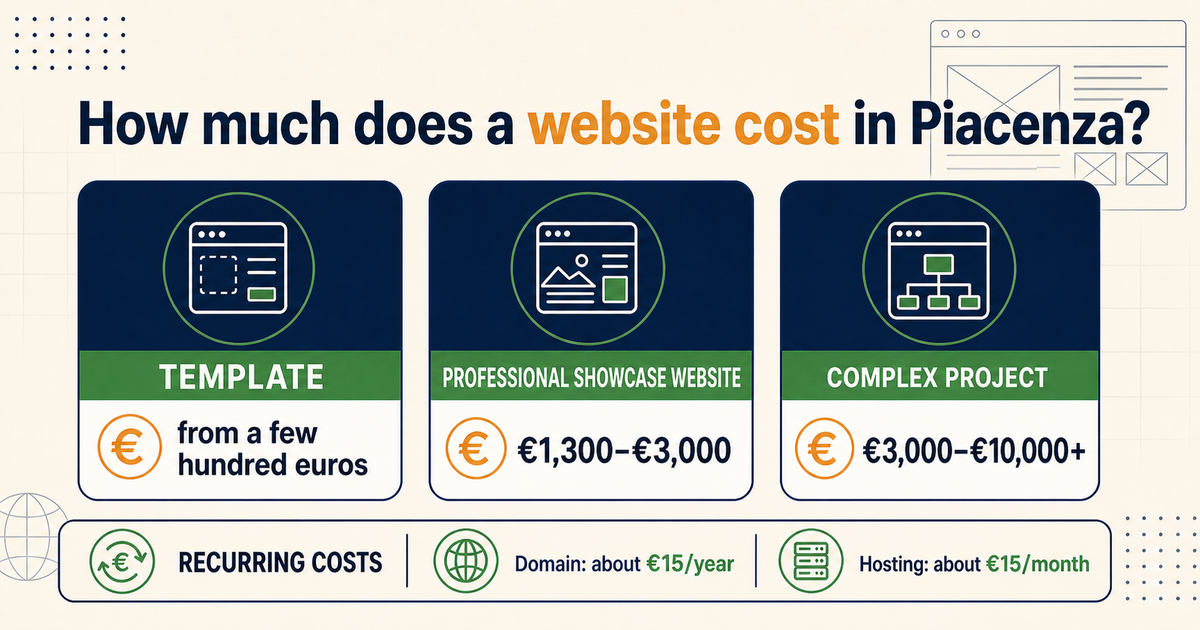
The cost depends on the number of pages, the amount of services, texts, design and functionality required.
A very simple site, built from a template and already ready content, can have a low price. A custom project requires analysis, structure, writing, design and development built around the profession.
With E-ROE, the initial development of a*professional customized showcase website *is reset from 1.500 € to 0 €. If the site convinces you and chooses to publish it, the service costs 480 € per year as a final price.
The base includes:
- strategic structure of the pages;
- custom design responsive;
- texts oriented to the contact request;
- fast and light development;
- optimization for smartphones;
- Basic SEO;
- contact form;
- WhatsApp button, when suitable;
- telephone and email connection;
- privacy and basic cookies;
- tracking of the main clicks;
- online publication.
The price can increase when the project requires:
- many service pages;
- more professionals or locations;
- multilingual version;
- reserved area;
- custom booking system;
- integrations with external software;
- photographic production;
- complex functions or modules;
- Continued SEO activity.
For a more general analysis of price ranges you can read the article on*how much it costs to make a custom showcase website *.
What recurring costs should be considered?
In addition to the initial realization there may be some annual or monthly costs:
- domain;
- hosting;
- maintenance;
- any licenses;
- booking tools;
- professional email boxes;
- updates and changes;
- SEO or subsequent marketing.
Before accepting a quote it is important to ask what costs are included, which will renew and who will own the domain and content.
Website monopage or site with multiple pages?
A monopage site collects all information on a single page. It can be suitable for a professional with a very simple offer and only one contact goal.
A site with multiple pages is generally preferable when:
- offer different services;
- you want to work on SEO;
- you have multiple locations or professionals;
- you must explain a complex method;
- you want to publish content;
- follow different publics.
You should not choose the solution with multiple pages in absolute, but the one that allows you to explain the activity without confusing the visitor.
If you are still undecided, the comparison betweenone page and multipage for professionalshelps you choose based on services, SEO and future growth.
Custom site or template?
A template allows you to start from an existing structure. It can be useful for essential projects, but requires you to adapt content and identity to a model created for generic activities.
A custom site is designed from the profession, services and questions of the public.
You can offer:
- greater coherence with professional identity;
- more precise structure;
- less useless elements;
- better performance;
- contacts built around the real process of work;
- greater differentiation than competitors.
You can deepen the comparison in the articlecustom web site vs WordPress*.
How does the first free E-ROE proposal work?
With E-ROE you do not need to purchase the site based on a quote or a theoretical description.
The process includes:
- Complete information:* We analyze profession, services, public, objectives, style and materials available.
- Creation of the first proposal:* We prepare a concrete, visible and navigable version.
- Notes:* Look at the site and decide if you want to proceed.
- Publication: If the proposal convinces you, we complete optimizations, domain, hosting and online messaging.
If the proposal doesn’t convince you and you don’t want to publish it, you don’t pay the site.
This allows you to evaluate structure, tone and graphic direction before facing the investment.
How to evaluate the estimate of a professional site
Before comparing two offers, check whether they include the same activities.
The most important questions are:
- Is design customized or based on a template?
- Who prepares the texts?
- How many pages are included?
- Are service pages included?
- Is the site also designed for smartphones?
- Is the basic SEO included?
- Are module, email, phone and WhatsApp configured?
- Privacy and cookies are provided?
- Can the site be changed in the future?
- Who manages domain and hosting?
- Are there any licenses or renewals?
- Is the tracking of contacts included?
- Who owns texts, images and code?
- Can I see something before I pay?
What errors avoid
Speaking too technical
The customer does not always know the language of the profession. The site must be precise, but understandable.
Use valid texts for anyone
If replacing your name with that of a competitor the text continues to work, it is probably not communicating a real difference.
Hide contacts
Telephone, email and main action must be easily reached, especially from smartphones.
Enter too many priorityless services
A long list does not help you understand what activities really represent the heart of your offer.
Use generic photos
Too artificial stock images can make the site similar to many others. When possible, it is preferable to show professional, team and real environment.
Making undemonstrated promises
Expressions such as “guaranteed results”, “the best” or “definite solution” can decrease credibility and, in some sectors, create deontological problems.
Rescue the mobile version
A substantial part of local and professional research is done by telephone. Small heads, tricky buttons to select and slow pages can make contact lose.
Does a showcase website automatically bring new customers?
No. The site does not generate requests only because it is published.
It must be connected to the channels through which people discover you:
- Google;
- Google Business Profile;
- pass it away
- social media;
- LinkedIn;
- advertising campaigns;
- events and networking;
- email and professional material.
The site is the central point where the potential customer can deepen and decide whether to contact you.
To see already developed sites, ecommerce and digital activities you can consultE-ROE oil*.
Conclusion: What should a professional’s website really have?
A professional showcase website must make clear services, public, method and contacts. It must build confidence without turning into an endless resume or aggressive advertising.
The most important pages are homepage, presentation, services, method, elements of trust, FAQ and contacts. The structure must then be adapted to the profession: a psychologist, a accountant and a dentist do not have the same audience and should not use the same language.
With E-ROE the initial development of the showcase website costs 0 € instead of 1,500 €. The annual service from 480 € is activated only if you choose to publish.
The result should not simply be a nice site. It must become the clear point where those who are looking for you can understand, trust and contact you.
Find out how the site of your professional activity might be
We prepare a first free proposal. If you like it, we publish it. If he doesn't convince you, you don't owe us anything.
♪ style="display: inline-block; margin-top: 10px; padding: 15px 29px; background-color: #ffffffff; color: #111827; text-decoration: none; border-radius: 6px; font-weight: 700;"> Write to us on WhatsApp♪ style="display: inline-block; margin-top: 18px; color: #ffffffff; font-weight: 700;"> Tell us about the project
Frequently asked questions about showcase websites for professionals
How much does a showcase website cost for a professional?
The price depends on pages, texts, design and functionality. With E-ROE the initial development is reset from 1,500 € to 0 €; if you publish, the annual service costs 480 € as a final price.
What pages should you have?
The basic structure includes homepage, presentation, services, method, elements of trust, FAQ and contacts. Pages dedicated to different services, locations or professionals can be added.
Do you need to enter the service price?
Not always. It depends on the profession and the possibility to define a standard price. When the cost varies, you can explain how the estimate is processed.
Need a page for each service?
It is recommended for the most important services, especially when responding to different needs and research. You do not need to create separate pages for almost identical services.
Should the site have a blog?
No. The blog is useful for SEO and authoritativeness, but can be added at a later stage. First it is important to correctly build the main pages.
Can I receive requests on WhatsApp?
Yes, when WhatsApp is consistent with the profession. Alternatively, phone, email, form or booking system can be used.
Can the site present more professionals?
Yes. You can create a team page and individual profiles with skills, qualifications and services of each professional.
Will the site be visible from smartphones?
Yes. A professional site must be responsive and maintain texts, menus, contacts and modules easily usable by smartphones.
Can the site help with local SEO?
Yes. Services, headquarters, contacts and territorial references can be arranged to make the activity more understandable to users and search engines.
Is it better to use WordPress or a custom site?
It depends on the needs. A custom site is more suitable when you want structure, design and content built specifically around your profession.
Can I see the site before paying it?
With E-ROE a first free and navigable proposal is prepared. You only pay if, after seeing it, you decide to proceed with the publication.